
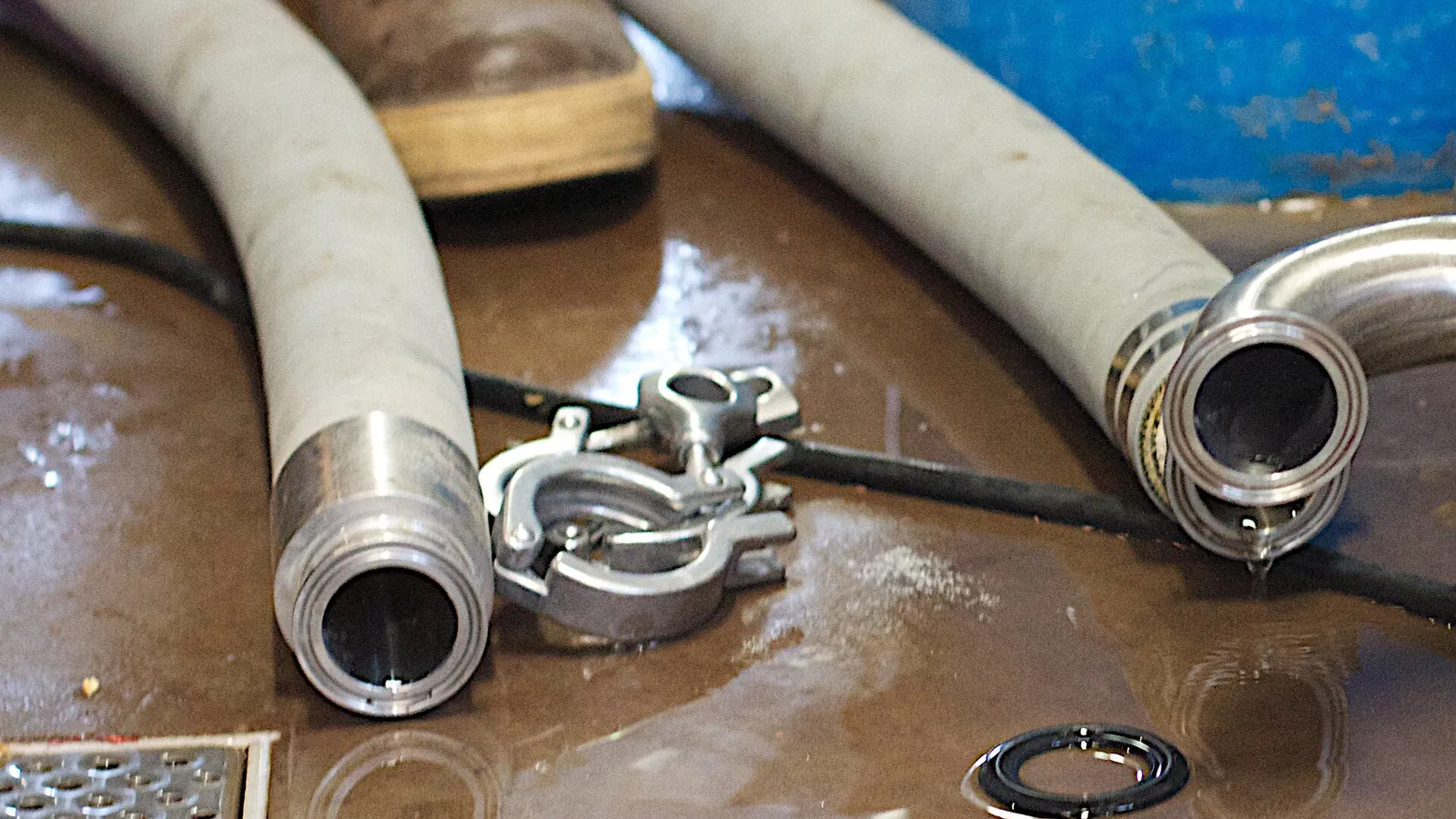
Choosing a food grade hose is a material decision first and a price decision second. The wrong compound taints the product or fails in the cleaning cycle — both expensive outcomes that a specification sheet prevents.
Start With the Standards
The product you transfer decides the standard you must meet:
- FDA 21 CFR 177.2600 — rubber compounds for repeated food contact (US)
- FDA 21 CFR 177.1550 — PTFE for food contact
- EU 1935/2004 — EU framework for food contact materials
- 3-A Sanitary Standards — dairy and processing equipment (US)
Ask your supplier for the certificate. If they cannot produce one, the hose is not food grade.
Match the Material to the Product
| Product | Recommended tube |
|---|---|
| Milk, juice, beer, soft drinks | EPDM |
| Edible oils, fats, shortening | NBR (nitrile) |
| Tomato paste, sauces, concentrate | UHMWPE lining |
| Wine, spirits | Clear PVC or EPDM |
| Aggressive CIP chemicals | UHMWPE or PTFE |
| Hot products / repeated autoclave | Platinum-cured silicone |
Check the Temperature Range
Every compound has a window: EPDM roughly -30°C to 120°C, NBR similar, UHMWPE to about 80-90°C continuous, silicone -60°C to 200°C, PTFE to 260°C. Hot-fill products and steam cleaning both push the upper limit — size the hose for the cleaning cycle, not just the product temperature.
Think About Cleaning
Food hoses must survive CIP (clean-in-place) cycles — caustic and acid washes, hot water, sometimes steam. A compound that is perfect for the product but fails in the washdown is the wrong choice. UHMWPE and PTFE linings win here because they resist the cleaning chemicals and stay smooth, so nothing holds on.
The Questions to Ask Before Buying
- What product, at what temperature?
- What cleaning regime (chemicals, cycles, steam)?
- What working pressure, what size?
- Are assemblies needed, or bare hose?
Send us those four answers and we come back with a specification — not a catalogue page. See our food grade hose range.