
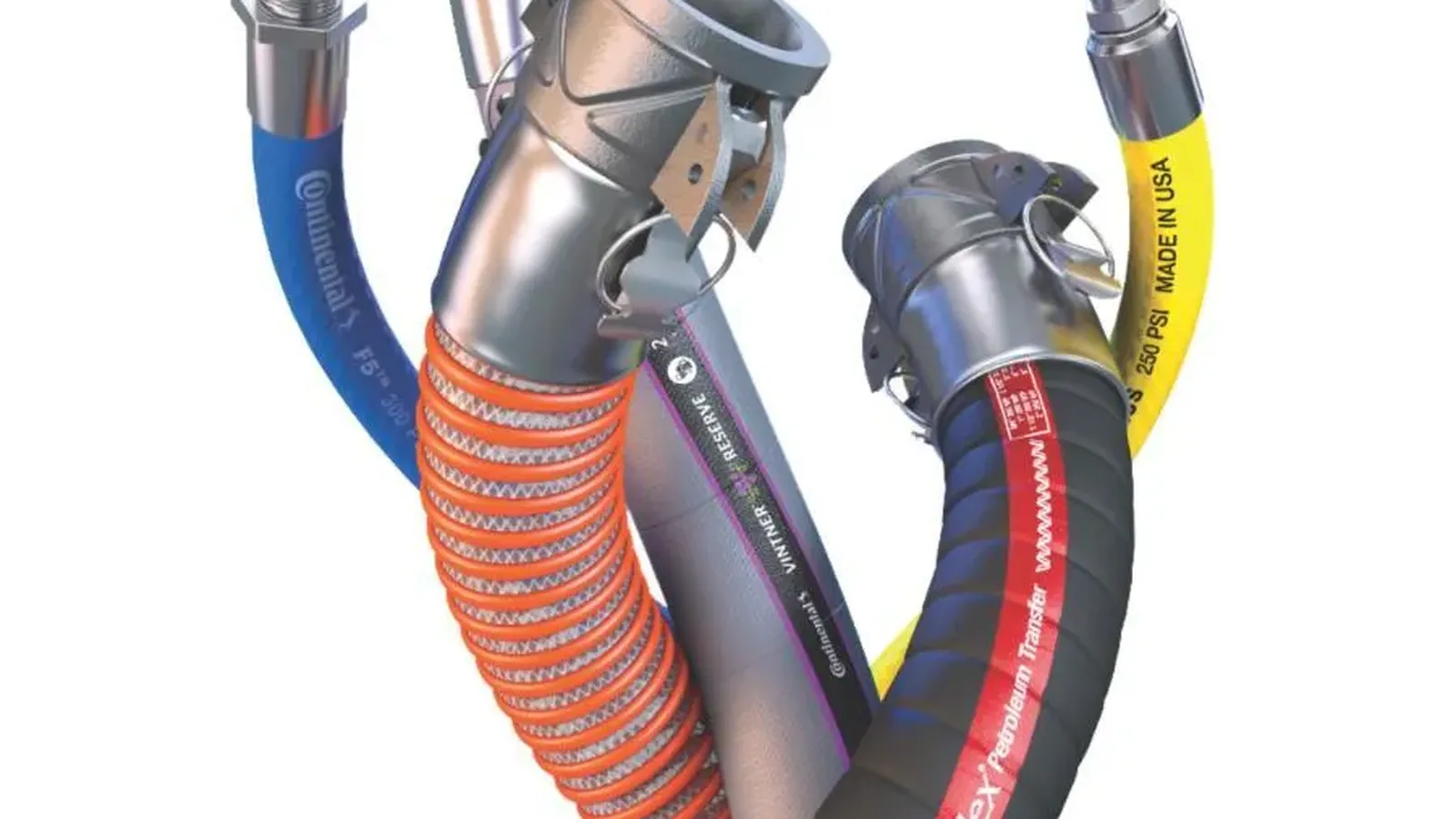
Five materials dominate food grade hose specification: NBR (nitrile), EPDM, UHMWPE-lined, silicone and PTFE-lined. Every food hose purchase is, at its core, a choice between these five — and the choice is rarely obvious because each one wins on a different axis.
This comparison puts them side by side on the axes that matter: temperature, product compatibility, cleaning resistance, mechanical behaviour and cost. Read the table, find the application that matches your process, and the right material is the one that wins your row.
The Head-to-Head Table
| Property | NBR | EPDM | UHMWPE-lined | Silicone | PTFE-lined |
|---|---|---|---|---|---|
| Continuous temperature | -30 to +100°C | -40 to +120°C | -20 to +80°C | -60 to +200°C | -200 to +260°C |
| Oils / fats | ★★★ | ✗ | ★★ | ✗ | ★★★ |
| Milk / dairy | ★★ | ★★★ | ★★★ | ★★★ | ★★★ |
| Acids (dilute) | ★★ | ★★★ | ★★★ | ★★ | ★★★ |
| Caustic CIP | ★ | ★★★ | ★★★ | ★★ | ★★★ |
| Steam | ✗ | ★★★ | ✗ | ★★★ | ★★★ |
| Abrasion resistance | ★★★ | ★★ | ★★ | ★ | ★★ |
| Flexibility | ★★★ | ★★ | ★★ | ★★★ | ★ |
| Bore cleanability | ★★ | ★★ | ★★★ | ★★★ | ★★★ |
| Relative cost | $ | $–$$ | $$ | $$$ | $$$$ |
| Typical service life | 1–3 yr | 2–5 yr | 3–6 yr | 3–7 yr | 5–10 yr |
When NBR Wins
NBR wins whenever the product is oily and the cleaning is gentle. Edible oils, margarine, lard, mayonnaise and oily sauces are the NBR domain — no other elastomer resists oil swelling like nitrile, which is why the classic orange food hose is NBR.
Choose NBR when: the product is oil-based; the line is cleaned with mild detergents or manual wash-down; the temperature stays below 100°C; cost matters.
Avoid NBR when: the line sees hot caustic CIP (it degrades); the product is acidic and hot (it hardens); steam cleaning is used (it blisters).
When EPDM Wins
EPDM wins whenever the process is hot, wet and cleaned hard — and the product is not oily. Dairy wash-down, brewery floors, hot water and steam transfer are EPDM territory. Its cleanability and steam resistance are the best of the elastomers.
Choose EPDM when: the product is water-based (milk, beer, juice without pulp); the line is CIP-cleaned with hot caustic and acid; steam service is involved; the hose must survive plant-floor abuse.
Avoid EPDM when: the product contains mineral or vegetable oil (it swells and fails); the temperature stays below -40°C; you need maximum flexibility in tight routing.
When UHMWPE-lined Wins
UHMWPE-lined hose wins whenever hygiene and cleanability outweigh temperature. The smooth, non-porous polyethylene bore gives dairy, wine and beverage lines a surface that bacteria cannot grip and CIP can clean in minutes. It is the standard answer for product-integrity lines.
Choose UHMWPE when: the product is flavour-sensitive (beer, wine, dairy, juice); the bore must be non-tainting and non-porous; CIP speed matters; the temperature stays below 80°C.
Avoid UHMWPE when: the process runs above 80°C; steam sterilisation is required; the product is heavily abrasive (the liner erodes).
When Silicone Wins
Silicone wins whenever temperature range and inertness beat mechanical toughness. From freezer lines at -60°C to sterilisation at 200°C, silicone covers the widest elastomer window, and its odourless, tasteless, non-toxic nature makes it the choice for the most sensitive products — brewing, baby food, flavouring, pharma intermediates.
Choose silicone when: the product is flavour-critical; the temperature window is extreme at either end; steam sterilisation is routine; flexibility in tight routing matters.
Avoid silicone when: the product is abrasive (it wears fast); the pressure is high and unbraided (use reinforced silicone); budget is tight (it is expensive).
When PTFE-lined Wins
PTFE-lined wins whenever nothing else survives. The ultimate chemical barrier operates from -200°C to +260°C, ignores essentially every chemical, and its non-stick bore is the easiest of all to clean. Hot chocolate, bakery fats, aggressive CIP chemistries, pharmaceutical intermediates — PTFE is the answer when the product is hot, sticky, aggressive or all three.
Choose PTFE when: the product is hot and sticky (chocolate, syrups); the chemical is aggressive (acids, solvents); steam sterilisation is required; maximum cleanability and service life justify the cost.
Avoid PTFE when: the budget is tight and the duty is gentle; the routing demands a tight bend radius (smooth-bore PTFE kinks — use convoluted); the application is a simple water line.
Decision Matrix by Application
| Application | First choice | Second choice | Why |
|---|---|---|---|
| Edible oil transfer | NBR | PTFE-lined | Oil resistance |
| Milk / cream lines | UHMWPE-lined | EPDM | Cleanable bore + 3-A |
| Brewery transfer | UHMWPE-lined | Silicone | Flavour integrity |
| Hot CIP wash-down | EPDM | — | Caustic + steam tolerance |
| Steam lines | EPDM | PTFE-lined | Steam resistance |
| Chocolate / bakery | PTFE-lined | Silicone | Non-stick + heat |
| Freezer / cryo transfer | Silicone | PTFE-lined | -60°C window |
| Pharma intermediates | PTFE-lined | Silicone | USP VI + cleanability |
| Fruit juice / pulp | UHMWPE-lined | EPDM | Acid + cleanability |
| Wash-down station | EPDM | — | Hot water + abrasion |
The Cost Question
Price differences between the five materials are real, but the calculation that matters is lifecycle cost, not purchase price. An NBR hose at one-third the price of a PTFE-lined hose that lasts twice as long and cleans in half the time is not the cheaper option — the PTFE hose is, once you count downtime, cleaning chemicals and replacement labour.
| Material | Purchase price (per metre, relative) | Typical service life | Lifecycle cost driver |
|---|---|---|---|
| NBR | 1.0× | 1–3 yr | Frequent replacement in hard service |
| EPDM | 1.2–1.5× | 2–5 yr | Replacement in oily service |
| UHMWPE-lined | 1.8–2.5× | 3–6 yr | Initial price; low maintenance |
| Silicone | 2.5–3.5× | 3–7 yr | Initial price; long life in good service |
| PTFE-lined | 4–6× | 5–10 yr | Highest initial; lowest lifetime in tough duty |
The rule of thumb: in gentle, oily service, NBR is the value choice. In hard, hot, hygienic service, the premium materials pay for themselves — and the cost of a failed hose (product loss, downtime, recall risk) dwarfs the price difference entirely.
How to Make the Decision in Three Steps
- Write down the product and its temperature. Oil or water? Hot or cold? This alone eliminates half the table.
- Write down the cleaning regime. CIP with hot caustic? Steam? Gentle wash-down? This eliminates most of the rest.
- Check the remaining candidates against the decision matrix. Two materials usually survive — pick the one whose weaknesses are irrelevant to your process.
Still unsure? Send us the product, temperature, pressure and cleaning details. We will come back with the material, the construction and a specification sheet — no catalogue guessing.