
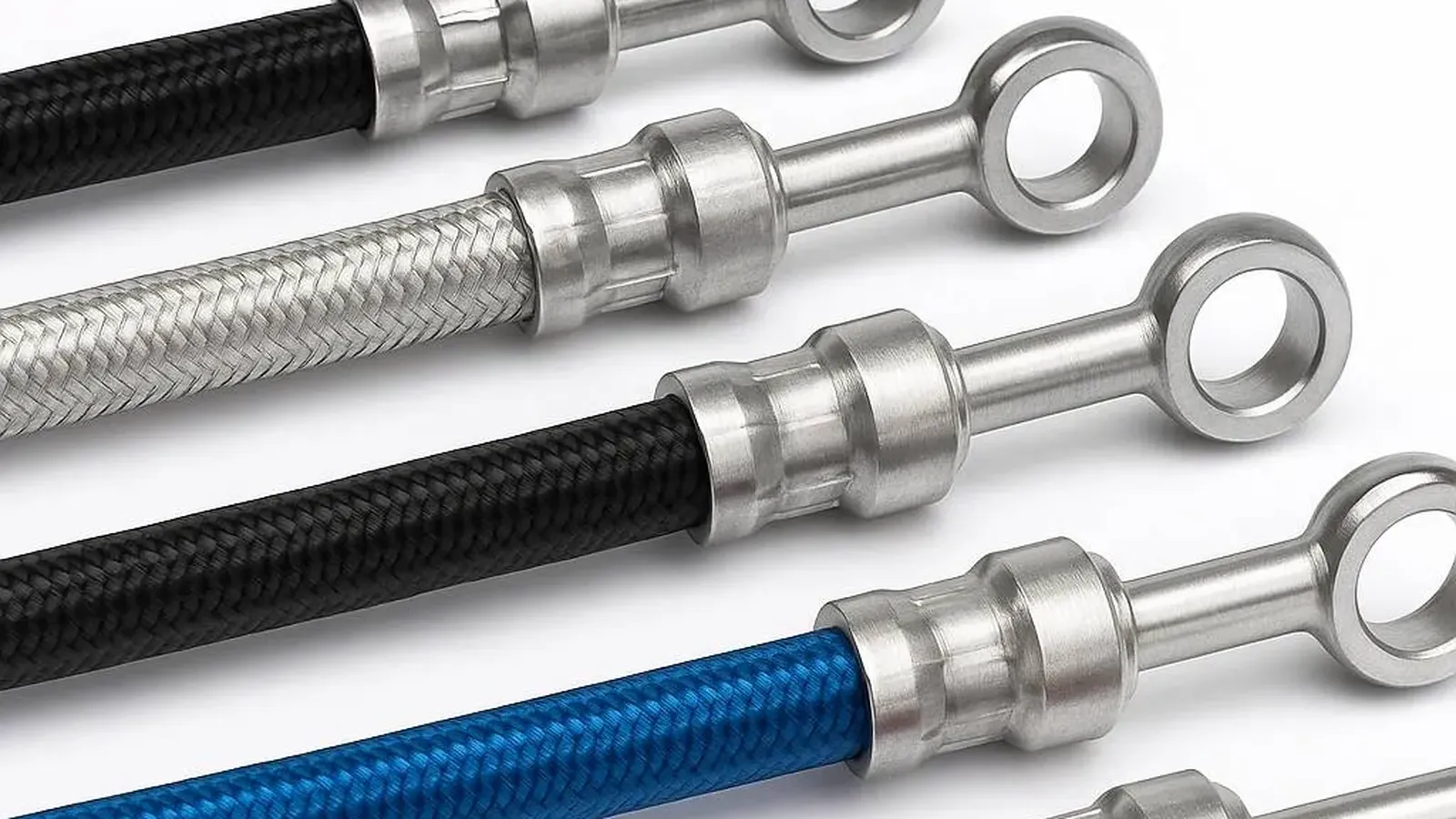
Stainless steel braided hose looks industrial because it is: a smooth core tube wrapped in a woven sleeve of stainless steel wire that carries the pressure, shields the core from abrasion and — in the worst case — keeps a burst hose from becoming a whipping hazard. It is the hose you see on espresso machines, hydraulic test rigs, chemical transfer lines and steam cleaning equipment.
This guide covers how the braid actually works, the core materials it protects, the SS304 vs SS316 decision, the ratings, and the one question buyers most often get wrong: braided hose vs corrugated metal hose.
How the Steel Braid Works
The stainless braid is not decoration and not armour in the simple sense — it is the pressure reinforcement. Woven at a precise angle over the core tube, the braid carries the hoop stress of the internal pressure, exactly like the wire braid in a hydraulic hose, but in stainless steel.
- The braid angle is engineered: the weave angle balances axial and hoop stress so the hose neither stretches nor kinks under pressure. Off-angle braid = premature failure
- The braid adds a second safety layer: if the core bursts, the braid contains the fluid and prevents the hose from whipping — the reason braided hose is specified where a burst must not become a projectile
- The braid protects the core: abrasion, rodent damage, impact and UV are absorbed by the steel, not the polymer core
- Multiple braids for more pressure: single-braid covers moderate duty; double-braid and interlocked constructions climb to very high pressures
Core Materials: What the Braid Protects
The braid provides the strength; the core provides the chemical, temperature and purity performance. Core choice is the real specification.
PTFE core (the dominant combination)
SS-braided PTFE hose is the classic: PTFE’s inertness and temperature range combined with stainless reinforcement.
- Temperature: −60 °C to +200 °C (up to 260 °C in special constructions)
- Chemical: essentially universal resistance — acids, bases, solvents, oxidisers
- Purity: non-contaminating, FDA/USP grades for food and pharma
- Also: smooth bore for low pressure drop, or convoluted for flexibility
- Typical use: chemical transfer, steam, high-purity food/pharma, laboratory
PVC or rubber core
Budget constructions with stainless braid for pressure and durability.
- Temperature: −20 °C to +80 °C
- Chemical: moderate (depends on compound)
- Typical use: beverage dispensers, water lines, light industrial
Silicone core
SS-braided silicone combines silicone’s purity and flexibility with steel strength.
- Temperature: −60 °C to +200 °C
- Typical use: food, pharma, high-heat transfer where rubber cores fail
Fluoropolymer-lined, metal-wrapped
For the top end of chemical and steam duty, PTFE-lined constructions with full stainless reinforcement (including convoluted metal hose — see below) carry the most aggressive service.
SS304 vs SS316: The Wire Grade Decision
Both grades braid well; the difference is corrosion resistance — and it matters exactly where you would expect: corrosive environments.
| Grade | Corrosion resistance | Typical use |
|---|---|---|
| SS304 | Good general resistance | Water, steam, mild chemicals, food service, general industry |
| SS316 | Superior — molybdenum addition resists chlorides, acids, salt | Marine, chemical plants, pharmaceutical, aggressive cleaning chemicals, coastal environments |
Rule of thumb: if the hose lives in a chemical plant, near the sea, or gets cleaned with aggressive chlorinated chemicals, specify SS316. If it carries clean water, steam or food indoors, SS304 is the economical correct choice. The core chemistry usually matters more than the braid grade — but a corroded braid defeats the reinforcement entirely.
Pressure and Temperature: Reading the Ratings
Ratings are the combination of core and braid:
- Working pressure follows the braid construction and core: single-braid SS/PTFE hoses are typically rated from a few hundred to ~1,000+ psi depending on size; double-braid constructions climb higher
- Safety factor — industrial hose is typically rated at a fraction of burst (the standard 4:1 design factor applies in hydraulic-style service; check the datasheet)
- Temperature follows the core, not the braid: the steel shrugs off 300 °C, but a PVC core fails at 80 °C. The hose rating is the core’s limit
- Size vs pressure: as with every hose, working pressure drops as bore size increases for the same construction
Always read both numbers from the datasheet for the exact size — the braid grade alone tells you nothing about pressure.
Braided Hose vs Corrugated Metal Hose: The Confusion, Resolved
The most common specification error in this category is treating stainless steel braided hose and corrugated metal hose as the same product. They are different tools:
| Property | SS braided hose | Corrugated metal hose |
|---|---|---|
| Structure | Polymer core + wire braid | Corrugated stainless bellows (+ braid) |
| Flexibility | Excellent (core flexes) | Good (bellows flexes) |
| Temperature | Core-limited (up to 260 °C) | Extreme (600 °C+) |
| Chemical | Core-dependent | Stainless everywhere |
| Vibration absorption | Good | Good |
| Cost | Lower | Higher |
| Typical use | Chemical, food, steam, hydraulic | High-temperature exhaust, extreme chemicals, cryogenics |
Choose braided hose for everyday chemical, food, steam and pressure duty; move to corrugated metal hose only when temperatures or chemicals exceed what any polymer core can take.
Applications
| Application | Typical construction | Why |
|---|---|---|
| Chemical transfer | SS316 braid / PTFE core | Corrosion + chemical resistance |
| Steam cleaning equipment | SS braid / PTFE or silicone core | Temperature + pressure |
| Food & beverage lines | SS304/316 braid / PTFE core | Purity + CIP chemicals |
| Hydraulic test benches | Double-braid SS | High pressure, burst safety |
| Espresso / beverage machines | SS braid / PVC or PTFE core | Pressure + aesthetics |
| Pharmaceutical transfer | SS316 / PTFE, USP grade | Purity + cleanability |
Five-Step Selection Process
Step 1 — Define the media. Chemical compatibility picks the core (PTFE for aggressive, silicone for pure, PVC/rubber for budget).
Step 2 — Define temperature. The core’s limit is the hose’s limit — confirm sustained and peak temperatures.
Step 3 — Define pressure. Working pressure + spikes → single or double braid.
Step 4 — Define the environment. Corrosive atmosphere, salt, cleaning chemicals → SS316; otherwise SS304.
Step 5 — Specify the assembly. End fittings (NPT, BSP, JIC, flange), length, and whether the hose ships pressure-tested.
Braid Parameters: What the Weave Actually Does
Two braid parameters govern performance, and both show up in the datasheet of a serious manufacturer:
- Braid angle: the wire is woven at a helix angle relative to the hose axis. An angle near the “neutral” balance point lets the hose hold pressure without growing longer or twisting under load. A braid angle optimised for burst pressure may behave poorly in cyclic service — one reason the datasheet’s impulse and flex ratings matter as much as the pressure figure
- Braid coverage / density: the percentage of the core surface covered by wire. Higher coverage means better pressure containment and abrasion protection; lower coverage means more flexibility and lower cost. “Full coverage” braid is the quality marker for pressure-rated hose
Two practical consequences: don’t field-repair a braided hose (a hand-applied clamp over a cut braid has no engineered braid angle and no pressure rating), and specify the braid construction, not just “stainless steel braided” — a 1×1 single braid and a 2×2 double braid are different products with different ratings.
Installation and Routing
Braided hose is strong, but installation determines how much of that strength survives:
- Bend radius: respect the datasheet minimum — the braid carries load at the bend, and over-bending work-hardens the wire at the inner radius
- Torsion is the quiet killer: the braid’s load balance is destroyed by twisting. Rotate the fitting, never the hose
- Vibration: support long runs and isolate the hose from machine vibration at the fittings — vibration fatigue concentrates at the termination
- Heat sources: the braid conducts heat efficiently — a hose near a hot surface heats the core through the braid. Keep clearances or use heat shielding
- Abrasion points: braid against sharp edges wears the wire; use sleeving or grommets at contact points
Acceptance Checklist for Braided Hose
- Core material confirmed for the media and temperature (PTFE/silicone/PVC)
- Braid grade confirmed (SS304 vs SS316) for the environment
- Working pressure and burst pressure read for the exact size
- Braid construction (single/double) matches the duty
- Fittings match the core (PTFE cores need special ferrules)
- Temperature rating confirmed from the core, not the braid
- Test documentation (proof pressure) attached
Stainless Steel Braided Hose FAQ
Q: Is SS braided hose food safe? The braid is inert; the core determines food safety. Specify an FDA-compliant PTFE or food-grade core and the complete assembly is food-safe.
Q: Why does my braided hose leak at the fitting? Most commonly a fitting issue, not a hose issue — incorrect crimp, wrong fitting for the core, or vibration loosening. Braided hose needs the fitting specified for the core material (PTFE cores require special ferrule designs).
Q: Can SS braided hose be used for steam? Yes, with the right core — PTFE or silicone cores handle saturated steam service within their temperature limits. Verify the rating for your steam pressure.
Q: SS304 or SS316 — which do I need? Water, food, steam, general industry → SS304. Chemical plants, marine, coastal, chlorinated cleaning → SS316. When unsure, SS316 is the safe upgrade.
Q: Do you supply SS braided hose assemblies with test documentation? Yes — PureFlow supplies SS braided hose assemblies in SS304 or SS316, with PTFE or silicone cores, pressure-tested with material certificates.
The Takeaway
Stainless steel braided hose is two components with one identity: the core carries the fluid’s chemistry and temperature; the braid carries the pressure and the safety. Specify the core for the media, the braid grade for the environment, and the assembly for the fittings — and the braided hose outlasts the machine around it.
If you are specifying stainless steel braided hose — send the media, temperature, pressure and environment — PureFlow will come back with the right core, braid grade and assembly, factory-direct.
- Stainless Steel Braided Hoses — the certified range
- PTFE Hose Complete Guide — the PTFE core in depth
- Chemical Transfer Hose Complete Guide — aggressive media logic
- Hose Assembly Guide — fittings and testing